




The Secret Engine:
How to Choose the Right Tennis String and Unlock Your Game
Introduction: The Unsung Hero of the Modern Game
Deep in the bowels of Arthur Ashe Stadium, far from the roar of the crowd, lies a fluorescent-lit room that hums with a quiet intensity. This is the stringing room of the US Open, the nerve center of the tournament's arsenal. Along the walls, hundreds of racquets stand at attention, each bearing a small tag—a cryptic set of instructions from the world's best players. A name: Medvedev. A string: Tecnifibre Razor Code. A tension, precise to a single pound. For a big match, a top player might request up to a dozen of these freshly strung weapons, each one a finely calibrated tool for the specific conditions of that day, that opponent, that weather.
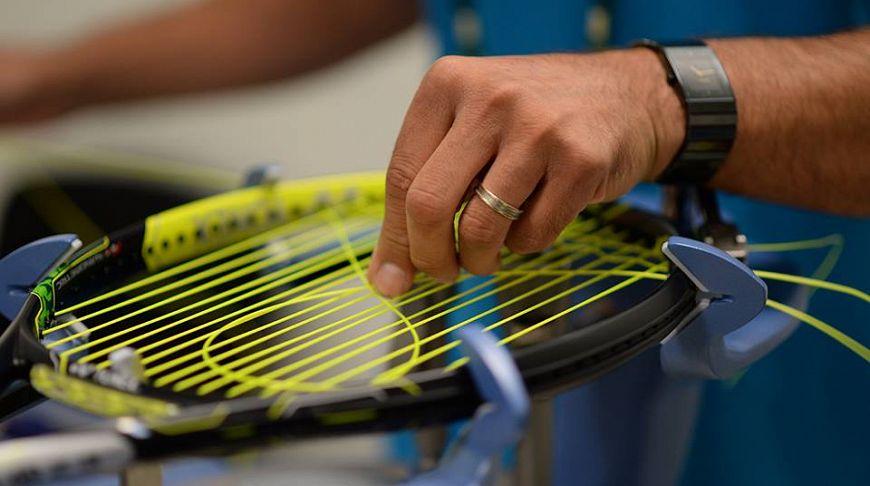
This scene reveals a central paradox of modern tennis. The strings—the very part of the racquet that makes contact with the ball—are the most critical, performance-defining component of a player's equipment. Professionals treat their string setup with the meticulous care of a master watchmaker, understanding that it dictates the power, control, and spin that underpin their entire game. Yet, for the vast majority of amateur players, strings are an afterthought, a part of the racquet ignored until the moment one snaps with a dull thud.
This report will unpack that paradox. It will reveal that the strings are not a passive net designed merely to catch and repel the ball; they are the racquet's engine. They are a technology that has fundamentally reshaped the physics of the sport, enabling the gravity-defying spin and blistering pace that define the modern game. By understanding the history of this technology, the science of its materials, and the intricate dance between player and string, any player can learn to read the code on those stringers' tags. This is a guide to decoding your own on-court DNA, transforming your racquet from a blunt instrument into a precision tool, and unlocking a new level of performance hidden in plain sight.
Part I: A History of Feel and Force — From Cow Guts to Co-Polyester
The journey to the modern string bed is not a simple, linear progression. It is a story of technological divergence, a tale of two distinct philosophies that created the diverse toolbox available to players today. One path pursued the perfection of feel and elasticity; the other chased control and spin through radical, counter-intuitive chemistry.
The Age of Gut (1875-1990s): The Serendipitous Discovery in a Butcher's Shop
The story begins not on a tennis court, but in Lyon, France, in 1875. A local maker of strings for musical instruments and sutures, Pierre Babolat, was approached with a novel request: to craft strings for the new English sport of "Lawn Tennis". The material he chose was not a futuristic polymer but something far more primal: the serous membrane of cow intestines. This was not, as a persistent myth claims, the gut of a cat; that legend stems from a misunderstanding of "catgut," an old term for the cord on a Welsh musical instrument called a "cat".
What Babolat discovered was a material with almost magical properties for tennis. Natural gut possessed a level of elasticity, comfort, and tension maintenance that no synthetic material has ever perfectly replicated. For over a century, it was the undisputed "gold standard," the string of choice for nearly every champion of the sport. Its organic, fibrous structure provided an unparalleled connection to the ball, a "feel" that allowed players to command their shots with supreme confidence. It was, and in many ways still is, the benchmark for playability.
The Synthetic Chase: Engineering the Ghost of Gut
The dominance of natural gut presented a clear challenge to engineers: could its performance be replicated at a lower cost and with greater durability? The mid-20th century saw the first serious attempts with the introduction of nylon strings. These early synthetics were more affordable and weather-resistant, helping to democratize the sport, but they were a pale imitation of gut's performance. They felt stiff, lost tension quickly, and lacked the sublime feel that players coveted.
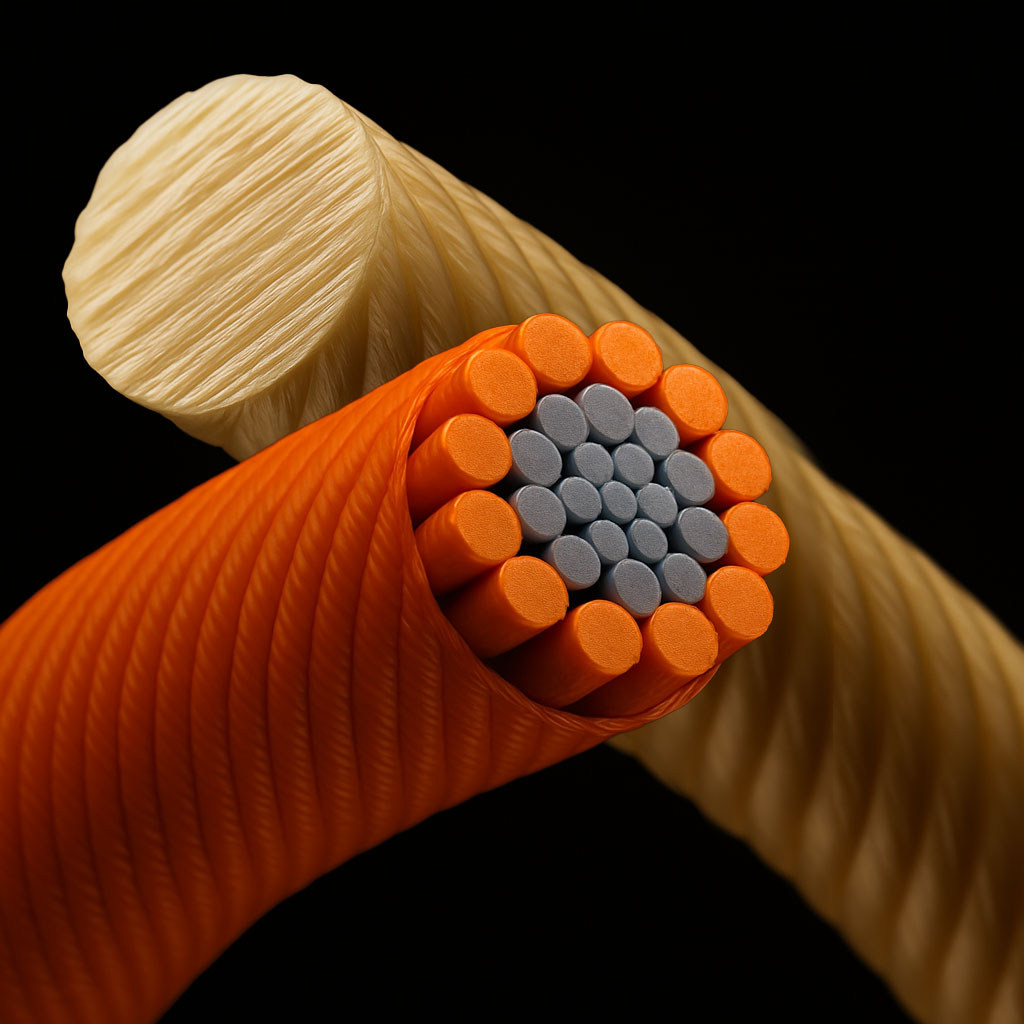
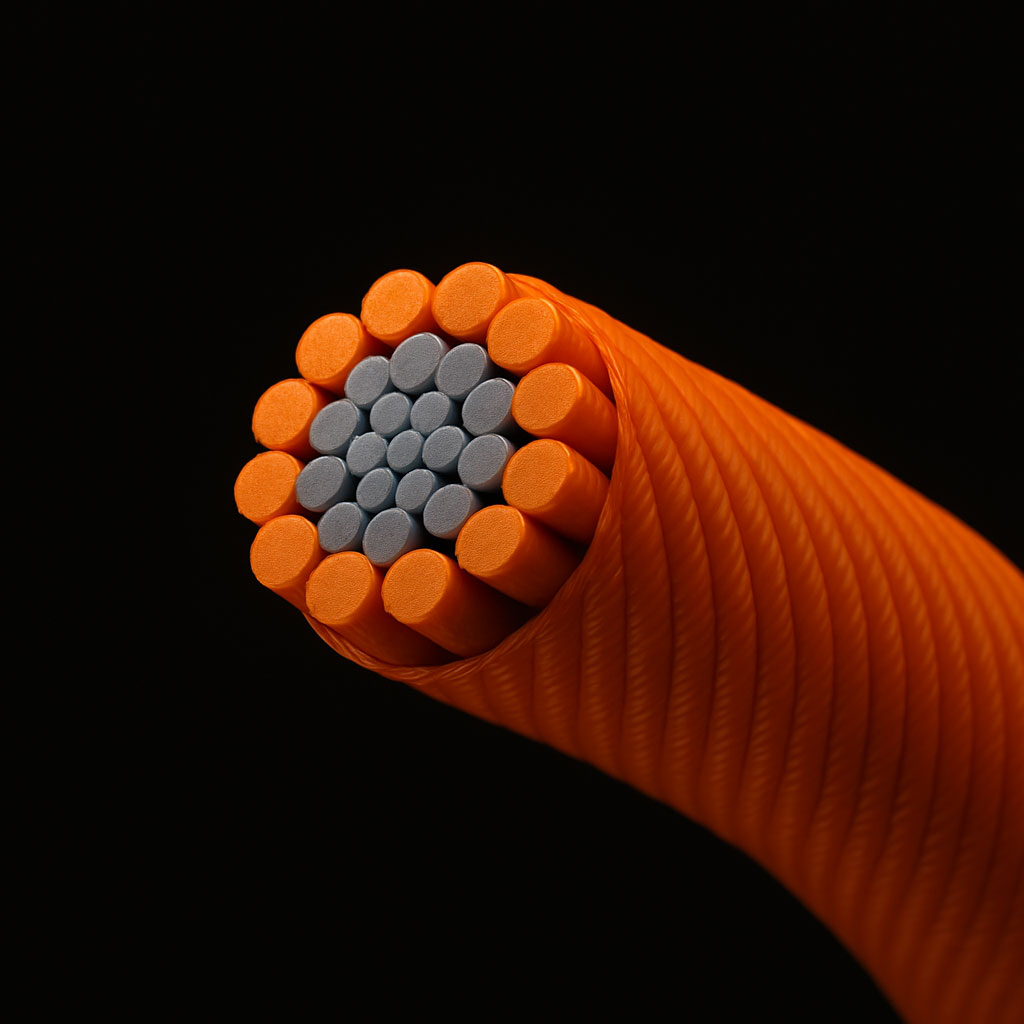
The real breakthrough in the synthetic chase came with the development of multifilament strings. Instead of a single, solid core, these strings were constructed from thousands of micro-fibers twisted and bonded together with flexible polyurethane, an engineering marvel designed to mimic the natural fibrous composition of gut. Companies like Wilson, with its iconic NXT line, and Tecnifibre, with its X-One Biphase, created strings that came remarkably close to gut's comfort and power. For players with arm injuries or those unwilling to pay the premium for natural gut, multifilaments became the go-to choice, offering a soft, cushioned response that absorbed the harsh vibrations of impact. Yet, even these sophisticated constructions couldn't quite capture the complete package—the unique combination of crispness, power, and tension stability that made gut legendary.
The Polyester Disruption (1997-Present):
The String That Killed Finesse and Rebuilt the Game
The narrative of string evolution takes a sharp, revolutionary turn at the 1997 French Open. A charismatic, unseeded Brazilian named Gustavo "Guga" Kuerten stormed through the draw to win the title, armed with a racquet strung with a "secret weapon": a stiff, wiry, seemingly "dead" string from a small Belgian company called Luxilon. This was not an evolution; it was a schism.
Polyester strings were not trying to be like gut. They were the antithesis. Where gut was soft and elastic, polyester was firm and unforgiving. Where gut provided power, polyester was low-powered, demanding the player generate their own pace. Its genius lay not in mimicking the past but in unlocking a new future through a novel physical principle. The key was its combination of stiffness and low friction. This unique pairing allowed the main strings to slide sideways across the cross strings upon impact and then violently "snap back" into their original position. This action grabbed the ball like a slingshot, imparting a level of ferocious topspin previously unimaginable.
The arrival of polyester created a fundamental divergence in string technology. It did not render natural gut obsolete; instead, it established a new, parallel evolutionary path. This is evident in the fact that even decades after the polyester revolution, top professionals like Roger Federer and Novak Djokovic continued to use natural gut in hybrid setups, blending its feel and comfort with polyester's control. Simultaneously, players like Rafael Nadal and a new generation of aggressive baseliners built their entire careers on a full bed of polyester, harnessing its unique properties to redefine the geometry of the game.
If polyester were strictly "better," gut would have vanished from the pro tour. Its persistence is proof that it retains unique, desirable qualities—unmatched comfort, power, and tension stability—that even the most advanced modern synthetics cannot perfectly replicate. The evolution of strings is therefore not a story of replacement but one of specialization. The modern player's choice is not about finding a single "best" string, but about selecting the right specialized tool from a diverse and sophisticated toolbox for a very specific job.
Part II: The String-Player Matrix: Decoding Your On-Court DNA
Choosing the right string is an exercise in self-awareness. It requires an honest assessment of your physical abilities, your strategic tendencies, and what you are ultimately trying to achieve on the court. Every string setup is a negotiation, a series of trade-offs between four fundamental performance currencies.
The Four Currencies of Performance: A Zero-Sum Game?
The universe of tennis strings is governed by a constant push-and-pull between four key benefits: Power, Control, Spin, and Comfort. Understanding this dynamic is the first step toward making an intelligent choice.
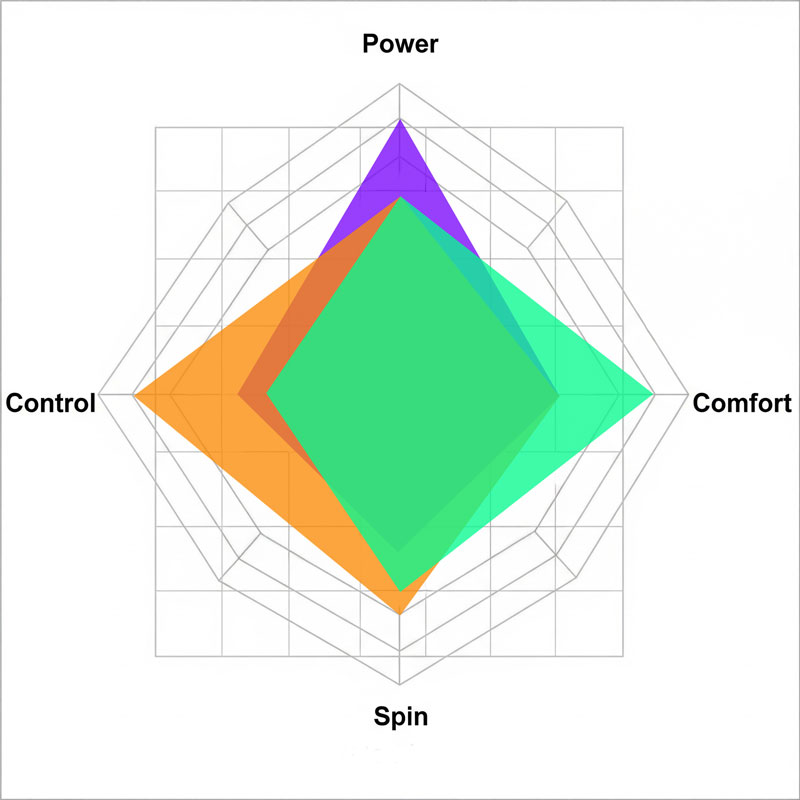
- Power: This is the "trampoline effect." Softer, more elastic strings like natural gut and multifilaments, especially when strung at lower tensions, stretch more upon impact. This greater stringbed deflection stores and returns more energy to the ball, launching it with higher velocity. For players who need help generating pace, a powerful string is a significant asset.
- Control: This is the anti-trampoline. Stiffer strings, most notably polyester, and higher tensions deform less on impact. This creates a more predictable, consistent, and lower-powered response. This might sound like a negative, but for players who generate their own immense power with fast swings, this dampened response is the very definition of control. It allows them to swing aggressively with the confidence that the ball will not fly long.
- Spin: This is the "snap-back" phenomenon, the secret engine of the modern game. For years, the conventional wisdom was that textured or "rough" strings gripped the ball to create spin. While texture can play a minor role, the primary mechanism is far more dynamic. Low-friction strings, particularly the slick surfaces of modern co-polyesters, allow the vertical main strings to slide laterally across the horizontal cross strings during the ball's 5-millisecond dwell time. As the ball begins to leave the stringbed, these displaced mains violently snap back to their original alignment, acting like a tiny slingshot that imparts massive rotational energy onto the ball.
- Comfort: This is about vibration absorption. The collision between a 57-gram ball and a racquet moving at high speed is a violent event, sending shockwaves up the player's arm. Soft, pliable materials like natural gut and multifilament are exceptionally good at dampening these vibrations, protecting the elbow, wrist, and shoulder from the cumulative stress that can lead to injuries like tennis elbow. Stiff strings like polyester, by contrast, transmit much more of this shock to the arm.
A Player-Style Diagnostic: Who Are You on the Court?
By mapping your playing style against these four currencies, you can identify the family of strings that will best complement your game.
The Aggressive Baseliners (The Spin Seekers)
- Player Profile: You live and die by the groundstroke. Your game is built from the back of the court, using heavy, high-arcing topspin to push opponents off the baseline and create attackable short balls. Your swing is fast, long, and vertical.
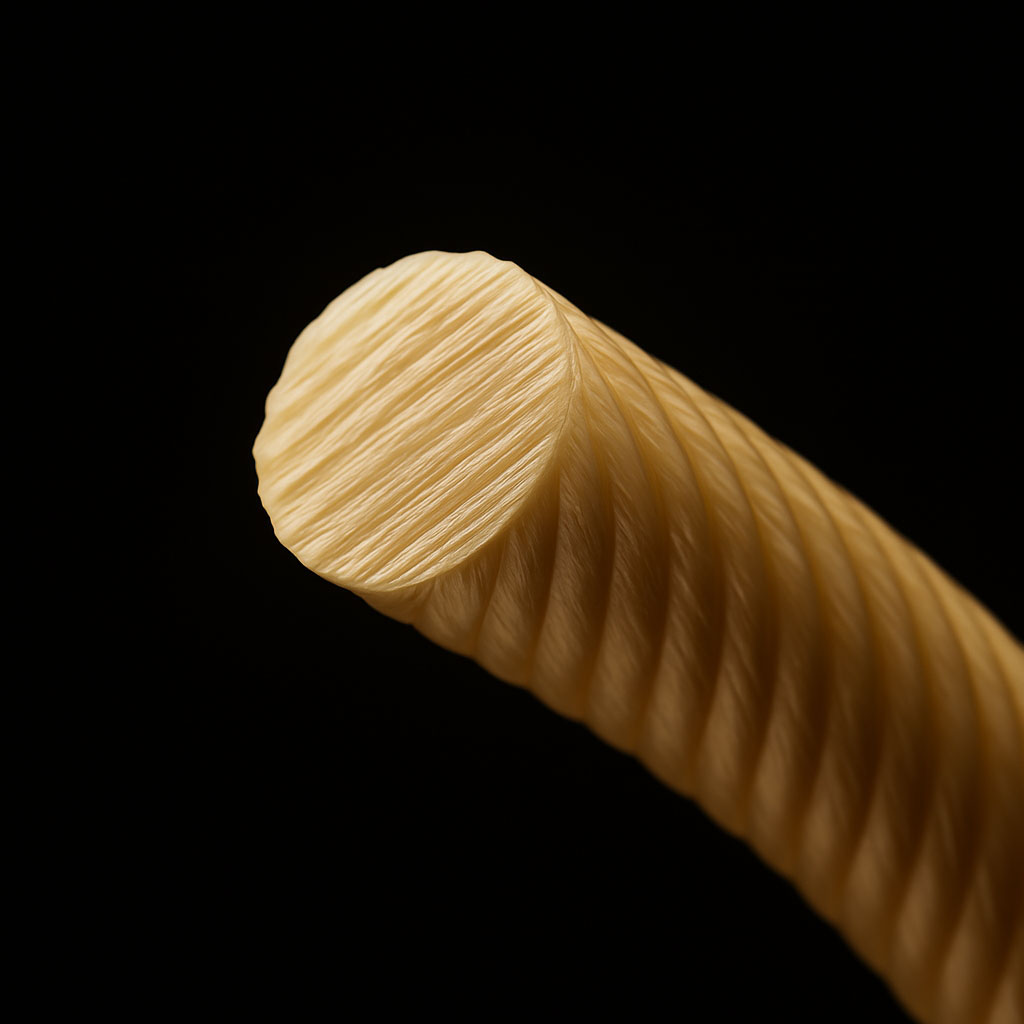
- Your String: A full bed of Polyester. You are the player for whom this string was invented. The inherent control of a stiff, low-powered string is essential to harness your powerful swing, allowing you to hit out without fear of the ball sailing long. More importantly, you need the unparalleled spin generation from the snap-back effect to make your heavy ball dip inside the lines and explode off the court. Look for shaped polyesters—strings with hexagonal, octagonal, or twisted profiles like Solinco Hyper-G or Babolat RPM Blast Rough—which use sharp edges to add a secondary "bite" on the ball, further enhancing spin potential.
The All-Courters & Counter-Punchers (The Control Freaks)
- Player Profile: You are a strategist. You win points not with brute force, but with precision, placement, and variety. You can flatten out a forehand down the line, absorb an opponent's pace and redirect it with a sharp angle, or chip and charge the net. Control is your ultimate currency.
- Your String: A control-oriented Polyester at a medium-to-high tension or a Performance Hybrid Setup. You require a firm, predictable stringbed that gives you immediate feedback and the confidence to hit your spots. A string like Luxilon 4G, known for its exceptional tension maintenance and control, would be a prime choice. Alternatively, a hybrid combining a polyester main string with a synthetic or multifilament cross can provide the needed control while softening the feel just enough for all-court play.
Find the best string for your game!
The Touch Artists & Net-Rushers (The Feel Fanatics)
- Player Profile: Your game thrives in the front half of the court. You win with subtlety: the feathery drop shot, the perfectly placed block volley, the angled slice that dies on the second bounce. You need to feel the ball sink into the strings, to have an intimate connection with every shot.
- Your String: Natural Gut or a premium Multifilament. For you, the stiffness of polyester would be like trying to paint a masterpiece with a broom. You need the superior elasticity and feedback that only the softest strings can provide. The ball pocketing effect—where the stringbed cradles the ball for a fraction of a second longer—is paramount for your touch-based game. Top-tier multifilaments like Wilson NXT, Tecnifibre X-One Biphase, or Babolat Xcel offer a gut-like experience in terms of comfort and feel, making them ideal choices.
The Developing Player & The Arm-Conscious Veteran
- Player Profile: You are either a beginner still developing the mechanics of a full swing, a junior player whose body is still growing, or a seasoned player with a history of arm ailments like tennis elbow.
- Your String: For this group, Comfort is non-negotiable. Your home base is Multifilament or Synthetic Gut. This is where a critical warning about polyester must be issued. There exists a fundamental and potentially dangerous disconnect between why professionals use polyester and why it is often marketed to recreational players.
This disconnect creates a paradox. Professionals, with their elite conditioning and hyper-fast swings, use stiff, low-powered polyester strings primarily for control—to tame the massive power they generate themselves and to unlock the spin from the snap-back effect. For this specific use case, it is a revolutionary tool.
However, polyester is often marketed to amateurs based on a different quality: its "durability". It simply takes longer to physically break than softer strings. This leads to a profound mismatch. Most amateurs and developing players lack power and need their equipment to help generate it. By choosing polyester for its durability, they are selecting the lowest-powered string type available, actively working against their own needs. Furthermore, unlocking polyester's signature spin requires immense racquet-head speed to engage the snap-back mechanism. Many club players do not swing fast enough to get this primary benefit, leaving them with a dead-feeling string that offers little advantage.
The danger lies in the string's stiffness. The shock from ball impact, which is manageable for a conditioned pro, is transmitted directly to the arm of an amateur. For a player with unpolished mechanics or a developing junior, this can be a direct path to injury. It is also crucial to understand that a string's physical durability is not the same as its "playability life." Polyester is notorious for losing tension and elasticity very quickly, often becoming "dead" and even harsher on the arm after just 10-20 hours of play, long before it breaks. For the vast majority of non-elite players, the perceived benefit of durability is a poor trade-off for a lack of power, diminished spin potential, and an increased risk of injury.
Part III: The Alchemist's Lab: Mastering the Variables
Once you have identified the right family of strings for your playing style, the real alchemy begins. Fine-tuning your setup involves manipulating three key variables: the specific material construction, the gauge (thickness), and the tension (tightness).
Material World: A Taxonomy of Tennis Strings
Within the four main families, there are nuances in construction that create a wide spectrum of feel and performance.
- Natural Gut: The undisputed king of feel, power, and tension maintenance. Made from ribbons of bovine intestine, its organic composition gives it a unique elasticity that is supremely comfortable on the arm. Modern versions include coatings that improve durability and resistance to humidity, but its primary drawbacks remain its high cost and relative fragility compared to polyester. It is the ultimate choice for players who prioritize comfort and feel above all else.
- Multifilament: The best synthetic approximation of natural gut. These strings consist of thousands of microfibers bundled together, creating a soft, cushioned, and powerful response. They are an excellent choice for players with arm sensitivities or those who want a gut-like performance at a lower price point. Their main weakness is durability; the fibers tend to fray with use and can feel "mushy" or unpredictable to players who prefer a crisper feel.
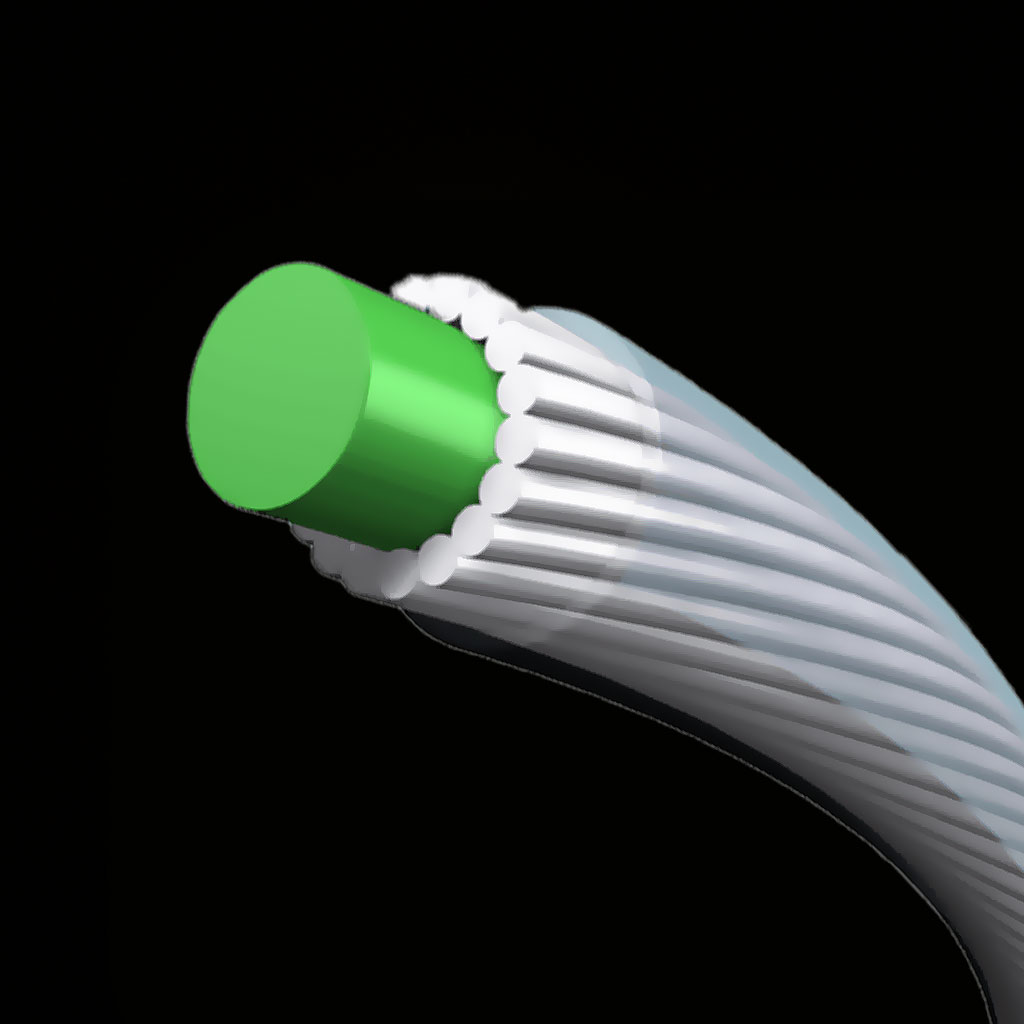
- Synthetic Gut: The reliable workhorse of the string world. Most synthetic guts are built around a solid monofilament core (usually nylon) with one or more outer wraps. This construction provides a crisp, clean feel and good all-around performance at an affordable price. It doesn't excel in any single category—it's not as comfortable as a multifilament or as spin-friendly as a polyester—but it offers a dependable baseline for a huge range of players.
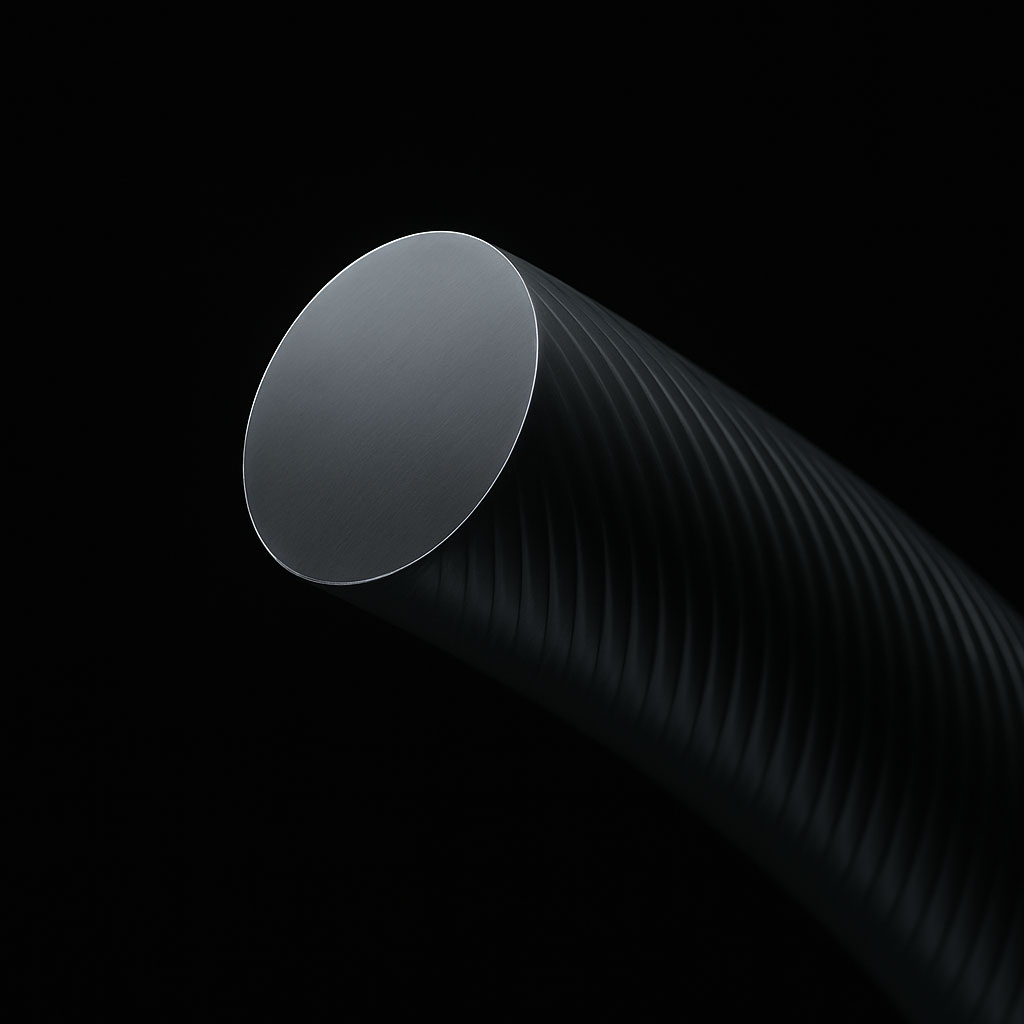
- Polyester (and Co-polyester): The weapon of the modern era. Constructed as a single, solid strand (a monofilament), polyester is defined by its stiffness. This stiffness provides the ultimate in control and durability, allowing aggressive players to swing freely. Its low-friction surface is the key to the "snap-back" spin effect. The downsides are significant: it is the least comfortable string type, is very low-powered, and loses tension and playability rapidly. Modern co-polyesters are modified with softening additives to improve the feel and elasticity slightly, making them more playable than the stiff, boardy polyesters of the first generation.
Table 1: String Material Cheat Sheet
| Material Type | Core Construction | Primary Benefit(s) | Signature Feel | Best For (Player Profile) | Key Weakness(es) | Price per Set |
|---|---|---|---|---|---|---|
| Natural Gut | Natural Fibers | Comfort, Power, Feel, Tension Maintenance | Elastic, Lively, Crisp | Touch Artists, Arm-Conscious Players | Cost, Durability, Weather Sensitivity | $40 - $60+ |
| Multifilament | Bundled Microfibers | Comfort, Power | Soft, Cushioned, Muted | Arm-Conscious Players, Feel Fanatics | Durability (fraying), Control (can be "mushy") | $12 - $25 |
| Synthetic Gut | Solid Core + Wraps | All-Around Playability, Value | Crisp, Clean, Direct | Beginners, All-Around Players, Budget-Conscious | Lacks standout performance in any one area | $5 - $15 |
| Polyester | Monofilament | Spin, Control, Durability | Firm, Stiff, "Dead" | Aggressive Baseliners, Frequent String Breakers | Lack of Comfort, Low Power, Rapid Tension Loss | $10 - $25 |
Data synthesized from various industry sources.
The Fine-Tuning Levers: Gauge and Tension
Once a material is chosen, a player has two primary levers to dial in the performance: gauge and tension.
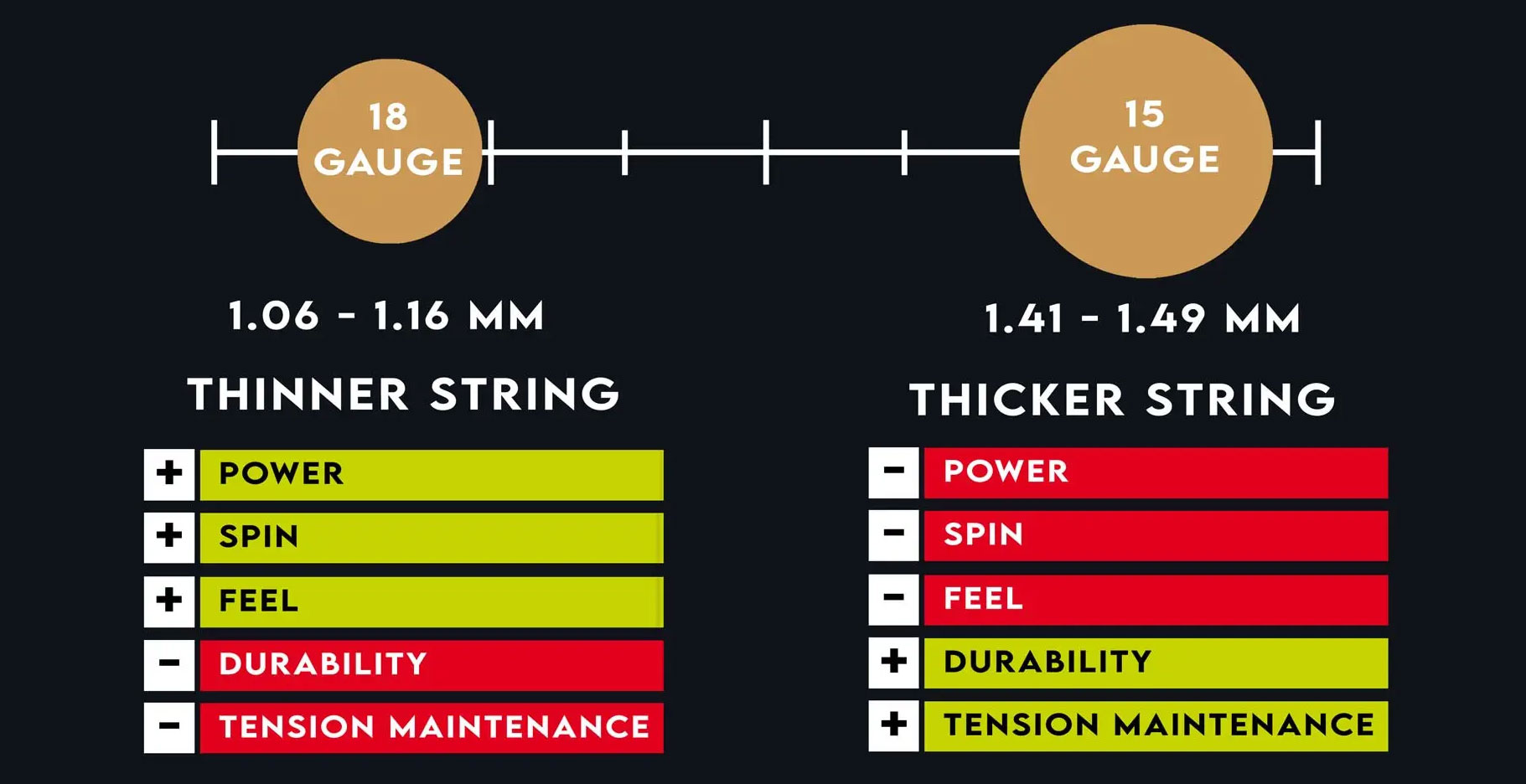
- Gauge (Thickness): Tennis strings are measured by a gauge number, where a lower number indicates a thicker string (e.g., 15 gauge is thick, 18 gauge is thin). The letter "L" after a number denotes a "light" or half-gauge (e.g., 16L is between 16 and 17). The trade-off is straightforward:
- Thinner Strings (17g, 18g): These strings can "bite" into and pocket the ball more effectively, leading to enhanced feel, comfort, and spin potential. The downside is reduced durability; they simply have less material and break more quickly.
- Thicker Strings (15g, 16g): These offer superior durability and are often perceived as providing more control due to their stiffer response. They are a good choice for chronic string breakers but sacrifice some of the feel and spin of their thinner counterparts.
- Tension (Tightness): Measured in pounds (lbs) or kilograms (kg), tension refers to how tightly the strings are pulled during the stringing process. The trampoline analogy is the most effective way to understand its effects.
- Lower Tension (e.g., 40-50 lbs): Like a loose trampoline, lower tension allows the stringbed to deflect more, pocketing the ball and launching it with greater power. This also creates a larger, more forgiving sweet spot and a more comfortable feel.
- Higher Tension (e.g., 55-65 lbs): Like a tight trampoline, higher tension results in less stringbed deflection. This reduces power and provides a more controlled, predictable response, which is favored by players who generate their own pace and prioritize precision.
A fascinating and often misunderstood aspect of modern tennis is the relationship between tension and spin. While conventional wisdom has long held that higher tension equals more control and spin, the physics of polyester strings have revealed a more nuanced reality. High tension certainly provides the directional control that allows a player to take the fast, aggressive swing needed to generate spin. However, the stringbed itself—the snap-back mechanism—actually produces more spin at lower tensions.
This is because lower tension allows for greater string movement and deeper ball pocketing. The main strings have more freedom to slide sideways and store elastic energy before snapping back. Multiple sources confirm that lowering tension increases spin potential. This explains the modern professional trend of stringing stiff polyester racquets at remarkably low tensions, with some players going below 45 lbs. They are finding a delicate balance: a tension low enough to maximize the spin-generating properties of the string, but high enough to maintain the directional control needed for their high-speed game.
Table 2: The Tension-Gauge Dial
| If You Want More... | Then Adjust Your Setup By... |
|---|---|
| Power | Lowering Tension (by 2-3 lbs) / Using a Thinner Gauge |
| Control | Increasing Tension (by 2-3 lbs) / Using a Thicker Gauge |
| Spin | Using a Thinner Gauge / Lowering Tension (with Polyester) / Using a Shaped Polyester |
| Comfort | Lowering Tension / Using a Thinner Gauge (of a soft string like Multifilament) |
| Durability | Increasing Tension / Using a Thicker Gauge |
Data synthesized from various industry sources.
Part IV: The Art of the Hybrid: Crafting Your Custom Cocktail
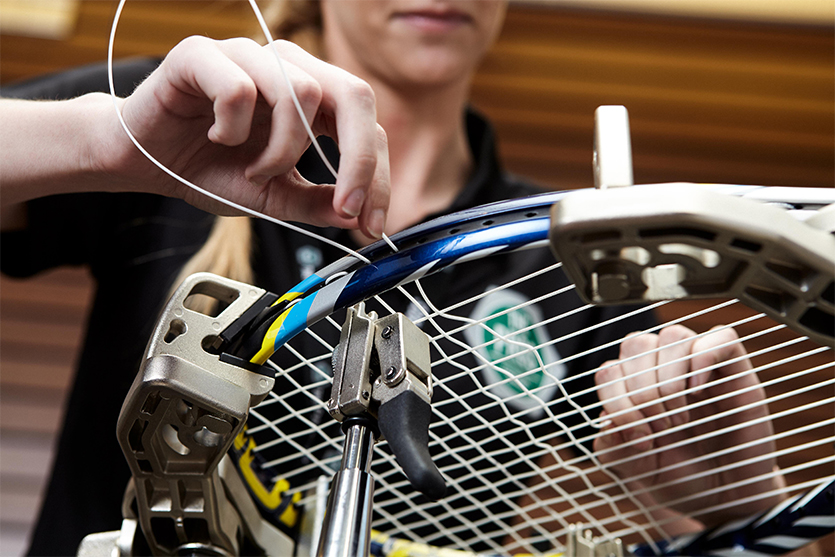
For the player who refuses to accept the standard trade-offs, there is hybrid stringing. This is the ultimate act of customization, the process of combining two different strings in the same racquet to create a unique performance cocktail tailored to one's exact preferences.
The Philosophy of the Hybrid: Getting the Best of Both Worlds
The core principle of hybrid stringing is that the main strings (the verticals) dominate the overall feel and playability of the racquet, contributing approximately 70% of its performance characteristics. The cross strings (the horizontals) are used to complement or "temper" the qualities of the mains. By understanding this principle, a player can move beyond simply choosing a pre-packaged hybrid and begin to engineer their own custom setup.
The Classic "Feel" Hybrid (The Federer Setup): Soft Mains, Control Crosses
- The Recipe: Natural Gut or a premium Multifilament in the mains, with a Polyester in the crosses.
- Why it Works: This configuration, famously used by Roger Federer for much of his career, prioritizes the sublime comfort, power, and feel of the soft string in the dominant main-string position. The polyester cross strings serve to rein in some of that power, adding a dose of control, enhancing durability, and introducing spin potential via the low-friction surface that allows the gut mains to slide and snap back. This is the setup for the player who wants the best possible feel but needs to add a modern element of control and spin.
The Modern "Performance" Hybrid (The String-Breaker's Solution): Control Mains, Soft Crosses
- The Recipe: Polyester in the mains, with a Natural Gut or Multifilament in the crosses.
- Why it Works: This is the most common hybrid setup on the professional and high-level competitive tours today. It leverages the exceptional control and spin of polyester in the all-important main strings, which also bear the brunt of friction and are most likely to break. The softer cross strings then serve a critical role: they increase comfort, absorb shock, add a touch of power, and mitigate the harsh, boardy feel that can come from a full bed of polyester. It is the pragmatic solution for the modern power player.
Advanced Hybrid Concepts: Poly/Poly and Gauge Mixing
The world of hybrids extends even further into niche customization. Some advanced players use poly/poly hybrids, combining a shaped, spin-friendly polyester in the mains with a smooth, round polyester in the crosses to fine-tune the balance of bite and snap-back. Others use a gauge hybrid, stringing a thicker gauge of the same string in the mains for durability while keeping a thinner, more playable gauge in the crosses to maintain feel. These advanced techniques demonstrate the nearly infinite level of personalization available to the dedicated tinkerer.
Rather than viewing the vast menu of hybrid options as a source of confusion, it is more effective to see hybrid stringing as an active, intelligent process of problem-solving. By internalizing the principle that the main string dictates the primary feel, a player can systematically diagnose issues with their current setup and use the cross string as the targeted solution. This transforms hybridizing from a guessing game into a logical method of personal optimization.
This process can be framed as a simple heuristic: "Put your problem-solver in the crosses." For example, a player who loves the spin and control of their full bed of polyester but is experiencing arm soreness has a clear problem: a lack of comfort. The solution is to keep the polyester in the mains to retain its desirable spin and control characteristics, but to introduce a soft multifilament in the crosses to add the missing element of comfort. Conversely, a player who loves the feel of their multifilament strings but is breaking them too frequently has a durability problem. A logical first step would be to keep the multifilament in the mains to preserve the feel, while installing a durable polyester in the crosses to extend the life of the stringbed. This diagnostic approach empowers the player to become the architect of their own equipment.
Table 3: Popular Hybrid Recipes & Their Effects
| Hybrid Name/Type | Main String (Material) | Cross String (Material) | The Resulting "Cocktail" | Best For (Player Profile) |
|---|---|---|---|---|
| The Pro's Choice (e.g., Wilson Champion's Choice) |
Natural Gut | Polyester | Maximum feel and comfort from the gut, tempered with the control and spin of the poly crosses. | The "Feel Fanatic" who wants to add modern control. (Federer's setup) |
| The Modern Competitor (e.g., Wilson DUO Power) |
Polyester | Natural Gut or Multifilament | Maximum spin and control from the poly mains, with added comfort and a touch of power from the soft crosses. | The "Aggressive Baseliners" seeking to reduce arm shock. |
| The Comfort Seeker's Hybrid (e.g., Wilson DUO Feel) |
Multifilament | Softer Polyester | A very comfortable and powerful setup that introduces some of the control and spin benefits of polyester. | Players with arm issues transitioning toward a more control-oriented setup. |
| The Budget Performance Hybrid | Polyester | Synthetic Gut | A cost-effective way to get the spin and durability of polyester mains while using an inexpensive, crisp-feeling synthetic gut to soften the stringbed. | Competitive juniors and club players looking for performance without the high cost of premium crosses. |
Data synthesized from various industry sources.
Conclusion: The Never-Ending Experiment
The journey to finding the perfect string setup is not a quest for a single, static answer. It is a dynamic and personal process of experimentation, a conversation between body, technology, and ambition. The most effective path forward is not to search for a magic bullet, but to adopt a methodical, iterative approach. The framework is simple:
- Start with a Baseline: Choose a full bed of string based on your honest player profile. An all-around club player might start with a 17-gauge synthetic gut at mid-tension (around 55 lbs). An aggressive, string-breaking junior might start with a 16L-gauge polyester at a lower tension (around 50 lbs).
- Play and Diagnose: After several hours of play, ask a simple question: What is the one thing you wish your strings did better? Do you need more power to get depth on your shots? More control to keep your attacking shots in? More comfort to soothe a sore elbow?
- Adjust One Variable: Based on your diagnosis, change only one thing at a time. If you need more power, try lowering the tension by 2-3 lbs. If you need more durability, try a thicker gauge. If you love your main string's characteristic but need to temper it, introduce a hybrid.
- Repeat: This continuous loop of playing, diagnosing, and adjusting is how players dial in a setup that feels like a true extension of their will.

As players engage in this personal experiment, the technology itself continues to march forward. The next great revolution in tennis strings may not be a new material, but a new system. Smart racquets embedded with sensors are already capable of tracking swing speed, impact location, and spin rate, offering players a level of data-driven feedback previously reserved for high-tech labs.
The theoretical next step, though perhaps distant, is the "active" stringbed—a racquet with microchips that could dynamically adjust string tension between points or even during the swing to optimize for power or control.
Alongside these performance-driven innovations, a crucial new trend is emerging: sustainability. The polyester revolution came with a hidden environmental cost. An estimated 24 million pounds of non-biodegradable polyester string end up in global landfills each year, where they will remain for centuries. In response, the industry is beginning to focus on eco-friendly alternatives. Innovative startups like Orobor are pioneering patented chemical recycling processes that can break down discarded polyester strings and transform them into high-quality fiber for new textiles, creating a circular economy for a product that was once purely disposable.
Ultimately, the quest for the perfect string is the quest to better understand oneself as a player. It is an acknowledgment that the racquet in your hand is not a static object, but a dynamic system waiting to be tuned. It is a conversation between your body and the laws of physics, played out one satisfying thwack at a time.